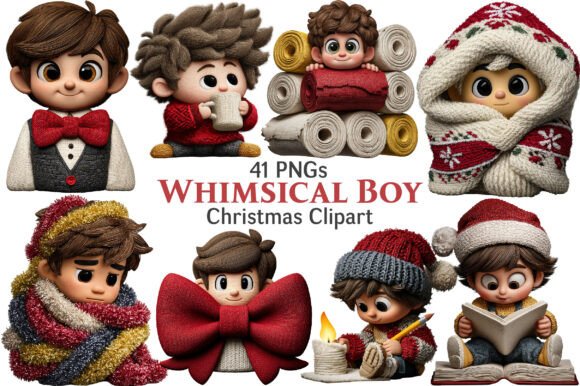
Reviewing Whimsical Christmas Boy Clipart for Stitching
As a designer who spends more time staring at stitch maps than actual fabric, I have learned that not every cute graphic translates well to thread. When I first pulled up the Whimsical Christmas Boy Clipart, my initial reaction was cautious optimism. The illustration style is charming, capturing that specific holiday nostalgia we all chase during the fourth quarter rush. But charm does not always equal stitchability. My job here is to look past the pretty pixels and determine if this asset holds up under the needle, especially for those of us running small shops or fulfilling custom orders where quality control is everything.
The First Impression: Mood and Visual Personality
The immediate vibe of this design is playful and soft. It avoids the harsh, rigid lines often found in generic holiday vectors, opting instead for a hand-drawn aesthetic that feels organic. For an embroidery project, this is a double-edged sword. Organic lines can look beautiful when executed with satin stitches, but they can also become jagged if the digitizer did not account for proper underlay or pull compensation.
The layout suggests a central focus, likely ideal for chest placements on sweatshirts or centered designs on tote bags. The visual personality leans toward "heirloom" rather than "mass-produced," which is exactly what modern buyers are looking for in handmade products. If you are an Etsy seller or a boutique owner, this kind of aesthetic helps differentiate your brand from the sea of identical, machine-generated holiday merch. It feels personal, which increases perceived value.
Real-World Application: From Screen to Sweatshirt
To test the viability of this design, I imagined a specific client request: a set of matching family pajamas and a personalized tote bag for holiday gift exchanges. This is a common scenario for craft business owners in November and December. The Whimsical Christmas Boy Clipart would serve as the anchor for these items.
For a sweatshirt embroidery project, the design’s whimsical nature pairs beautifully with the cozy texture of fleece or French terry. However, you must consider the fabric texture. Thick fabrics require longer needles and potentially adjusted tension. If the design relies heavily on fine details, they might get lost in the pile of a plush material. In this case, I would recommend using a cutaway stabilizer to ensure the design remains crisp and does not distort after washing. The result should be a finished product that looks intentional and high-end, reinforcing customer trust in your craft business.
When applied to a canvas tote bag design, the stakes change slightly. Tote bags are workhorses; they get tossed in cars and washed frequently. Here, the durability of the stitch density becomes critical. If the digital embroidery file has sparse fill stitches, the background fabric might show through, looking cheap. Conversely, if it is too dense, the bag might pucker. A balanced approach is key. This clipart, with its likely moderate complexity, seems well-suited for medium-weight canvas, provided you use a sturdy tear-away or cutaway stabilizer depending on the desired drape.
Navigating Technical Challenges
While the design is appealing, there are areas where caution is necessary. Any experienced embroidery designer knows that small hoop sizes can be tricky with detailed illustrations. If you plan to use this on a cap or a small embroidered patch, you must verify the scale. Tiny details, such as facial features or small accessories in the boy’s hands, may need to be simplified or enlarged to prevent thread breaks and bird nests.
Dark fabrics present another challenge. If you are stitching this onto a navy or black garment, you cannot rely on the fabric color to define shadows. You must ensure the thread colors have enough contrast. A quick test in black and white mockups can reveal if the design loses its definition without color cues. Additionally, curved surfaces like baseball caps require careful hooping and possibly a different digitizing strategy than flat items. If the original file was not specifically digitized for caps, you might experience distortion along the seams.
Stretchy fabrics, such as those used for baby embroidery on onesies, require extra attention. The Whimsical Christmas Boy Clipart must be stabilized properly to prevent the stitches from pulling the fabric out of shape. Using a lightweight cutaway stabilizer is often safer than tear-away for stretchy knits, ensuring the personalized gift retains its shape wash after wash.
Enhancing Brand Consistency and Buyer Engagement
Beyond the technical aspects, this design impacts how your brand is perceived. High-quality Illustrations that translate well into thread signal professionalism. When a customer receives a custom apparel item with clean, well-executed stitching, they are more likely to leave positive reviews and return for future purchases. This design supports brand consistency if your shop focuses on nostalgic, family-oriented, or whimsical themes.
For digital product sellers, offering this as part of a bundle or using it in printable mockups can boost engagement. However, always confirm licensing before selling finished items or digital products. Just because a file is available does not mean it is cleared for commercial embroidery. Check the terms carefully to avoid legal issues down the line.
Practical Notes for the Embroidery Designer
Before committing to a large production run or a high-value client order, follow these practical steps:
- Test on scrap fabric: Always stitch out a sample on the same type of fabric you intend to use for the final product. This reveals issues with tension and density.
- Check thread color contrast: Ensure your chosen thread palette highlights the design’s features without muddying the details.
- Review stitch density: Look for areas that might be too dense for thin fabric or too sparse for thick fabric.
- Confirm hoop size: Make sure the design fits comfortably within your machine’s hoop, leaving room for proper stabilization.
- Inspect small details: Zoom in on the digitized file to check for potential jump stitches or unnecessary trims that could weaken the design.
- Use proper stabilizer: Match the stabilizer to the fabric weight and stretch. Do not guess; this is the foundation of good embroidery.
In conclusion, the Whimsical Christmas Boy Clipart offers a delightful aesthetic that, when handled with technical care, can elevate your holiday offerings. It is not just a picture; it is a component of your brand’s story. By respecting the limitations of the medium and preparing thoroughly, you can turn this digital asset into a tangible, cherished keepsake for your customers.